Retaining Walls in Tuscarawas County, OH
Large decorative retaining walls, placed with equipment one piece at a time. A good wall holds your slope and gives you back usable yard.
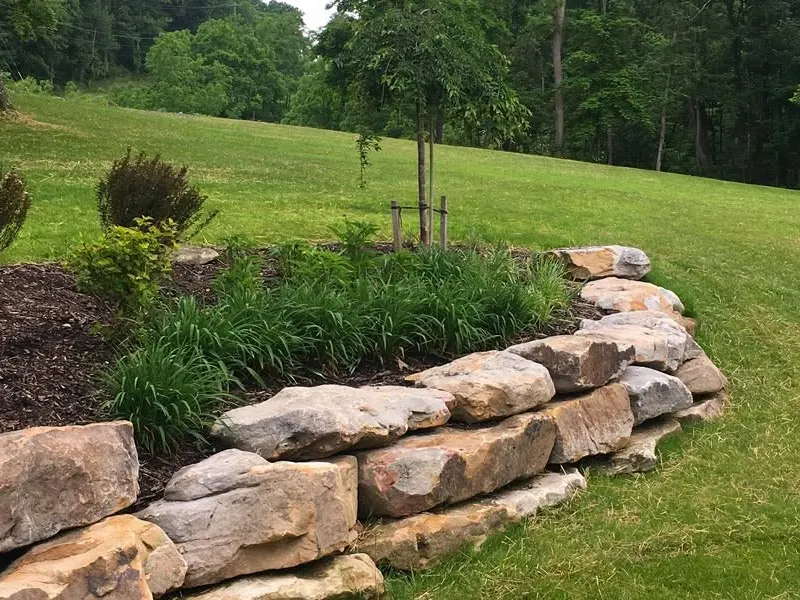
A retaining wall is a wall built to hold back soil where the ground changes height, so a slope stays put and the space above and below it can be used.
Pro Dirt Works builds large decorative retaining walls around Sugarcreek and Tuscarawas County, set with equipment for function and looks. What makes a wall last is mostly hidden: a compacted base under it and drainage stone with an outlet behind it, built for Ohio freeze-thaw. Taller walls, or walls carrying extra loads, may need an engineered design.
Retaining Walls Built to Stay Put
A retaining wall turns a slope into ground you can use. It can level off part of a backyard, or hold a hillside back from a driveway. It can make room for a shed pad or patio. Sometimes it's mostly about looks, and that's fine too. Pro Dirt Works builds large decorative retaining walls around Tuscarawas County, set with equipment and careful placement so each piece sits where it belongs. Big wall pieces are heavy. Setting them by machine lets us build walls that would be a real fight by hand. Still, the part of a wall that matters most is the part you never see: the base under it and the drainage behind it.
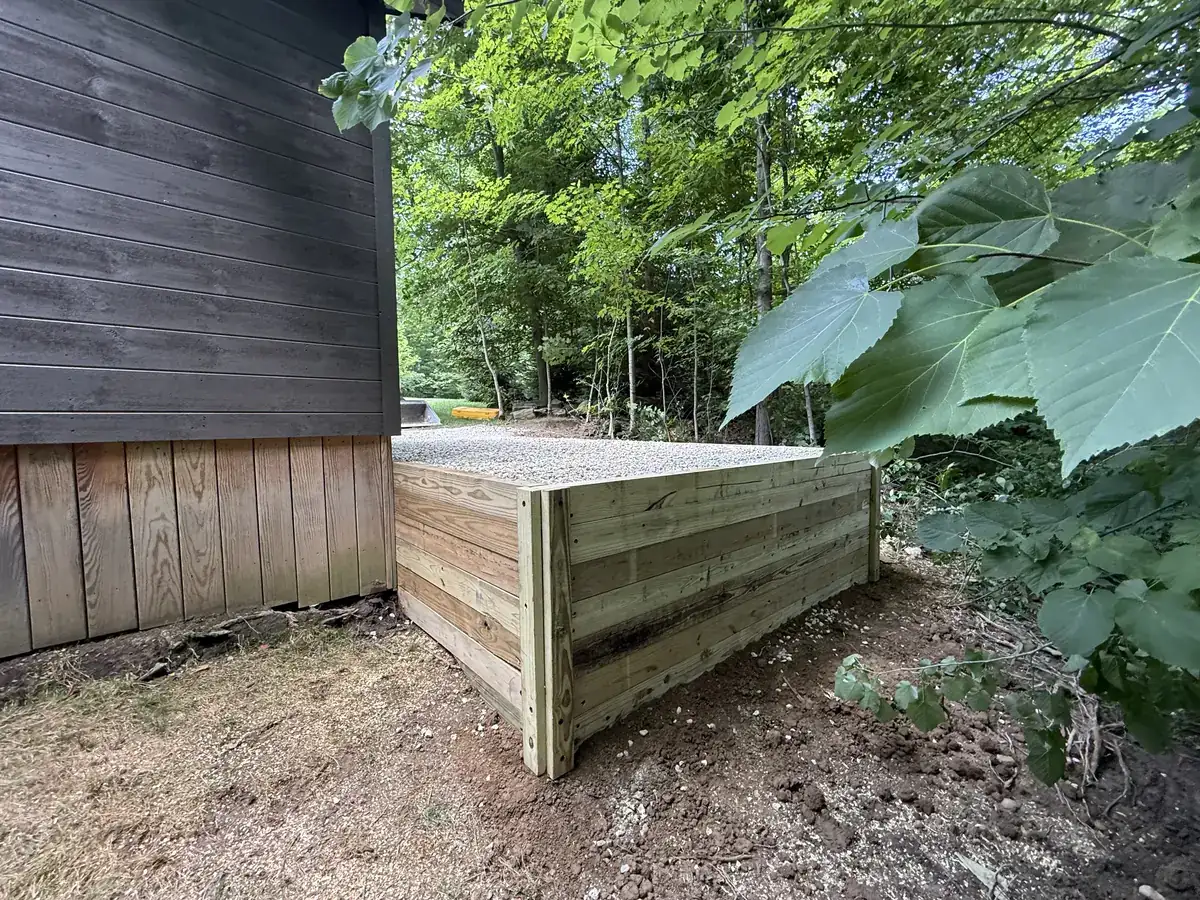
Every good retaining wall starts below grade. We dig a trench for the base and take out soft or organic soil. Then we build up compacted crushed stone so the first row has a firm, level place to sit. That bottom row usually sits partly below the finished grade, so the wall can't kick out at the toe. If the first row is off, every row above it is off too. So we take our time there. On soft or wet ground the base may need to go deeper or wider. Getting the base right costs time up front, and it's the main reason one wall stays straight while the one down the road starts leaning after a few winters. Nobody sees the base once the wall is up, so it's the easiest place for a careless crew to cut corners. We don't.
Water is what ruins retaining walls. Soaked soil weighs a lot more than dry soil, and all that extra weight leans on the back of the wall. So we put drainage stone behind it, clean crushed stone that lets water drop through instead of building up. A perforated drain pipe often runs along the bottom of that stone to carry the water out. It has to have an outlet, either out the end of the wall or to a lower spot on the property. A pipe with no outlet just fills up and sits there. We also look uphill. If a downspout or a driveway is sending water toward the wall, we deal with that too, with grading or a swale. The less water a wall has to hold back, the longer it stays straight.
Then there's winter. Water in the soil behind or under a wall freezes, expands and thaws, over and over, all winter long. That can heave a wall out of line or push pieces loose. Mostly the fix is the same stuff that makes a wall strong to begin with: stone under and behind the wall that drains freely, and an outlet so water never sits. Heavy clay holds water and swells when it's wet, so it shouldn't be packed right up against the back of a wall. We'd rather spend extra time and stone now than have you staring at a bulge in the wall a few springs from now. A wall has to get through a lot of Ohio winters, so we don't rush the base.
Height changes the rules. Section 404.4 of the Residential Code of Ohio covers it. A retaining wall that isn't braced at the top and holds back more than 48 inches of unbalanced fill has to be designed using accepted engineering practice. So does a wall over 24 inches tall that also resists loads other than the soil. That design checks the wall against overturning, sliding, too much pressure on the ground below it, and water uplift. In plain terms: if your wall will hold back more than about four feet of dirt, or a driveway or building near the top will put extra load on it, plan on an engineered design. We'll tell you if your wall crosses that line before any digging starts. Your local building department has the final say on permits for your property.
Common Uses for Retaining Walls
- ✓Leveling a sloped backyard for lawn or a patio
- ✓Holding a hillside back from a driveway or building
- ✓Cutting a flat spot into a slope for a shed pad
- ✓Terracing a steep yard into level sections
- ✓Decorative walls that finish off a yard or entrance
Why Choose Retaining Walls
Heavy pieces set by machine
Equipment lets us place big wall pieces exactly where they go, so the wall goes up straight and tight.
Built from the base up
A compacted stone base and a dead-level first row. Everything above depends on those two.
Drainage done right
Drainage stone and an outlet behind the wall keep water from piling up and pushing on it.
Back within one business day
If anything's wrong with a wall we built, we're back within one business day to make it right.
Our Retaining Walls Process
Send photos of the slope to (330) 988-4342. David can often give a rough price range from them.
We meet at the site and talk through height, length, look and drainage. If the wall will need an engineered design, we tell you then.
Ohio811 gets notified. Then we dig the base trench and build a compacted stone base.
We set the wall with equipment. Drainage stone and pipe go in behind it as it goes up.
Last, we backfill and grade the area so it drains. You're left with ground ready for planting or seed.
Retaining Walls Pricing
Length and height matter most. After that it's the material, how much digging and base stone the wall needs, drainage, and access for equipment and deliveries. Whether the wall needs an engineered design matters too. Text a few photos to (330) 988-4342 and we can often send a rough price range the same day. Estimates are free.
Retaining Walls FAQ
Common questions about retaining walls in Tuscarawas County and East-Central Ohio.
Length and height matter most. After that it's the material, how much digging and base stone the wall needs, drainage, access for equipment and deliveries, and whether it needs an engineered design. A short garden wall and a tall wall holding back a hillside are very different jobs. Text photos of the spot for a rough range, or set up a free estimate.
Section 404.4 of the Residential Code of Ohio says a wall that isn't supported at the top and retains more than 48 inches of unbalanced fill must be designed using accepted engineering practice. The same goes for a wall over 24 inches tall that resists loads besides soil, like a driveway or building near the top. Check with your local building department about permits.
Usually it comes back to the base or the water. A weak base lets the wall settle and tip. Water trapped behind the wall adds weight, then freezes in winter and pushes even harder. Walls built taller than their design can handle fail too. Get the base and the drainage right, match the design to the height, and most of these problems never show up.
Nearly all of them do. Wet soil is heavier than dry soil and pushes harder on the wall, and in winter that water freezes and expands. Clean stone behind the wall, usually with a drain pipe at the bottom that has a real outlet, lets the water out before it does damage.
Yes. A wall can hold the high side or the low side of a slope so a level pad fits. We started out building gravel pads for storage sheds, so we think about the pad, the wall and the drainage together. For a smaller grade change, a timber-framed gravel pad may be all you need. We'll tell you which makes more sense.
We take most excavation jobs within about an hour of Sugarcreek, which covers Tuscarawas County and parts of the counties next to it. Not sure you're in range? Call or text (330) 988-4342 and ask.
Related Services
Where We Offer Retaining Walls
Last updated
Ready for Retaining Walls?
Get a free, no-obligation estimate for your retaining walls project.
Serving Tuscarawas County and East-Central Ohio · Mon-Sat 8am-5pm